Beyond Our Walls Feb 2026
From
Applied Performance Innovation
Your brain after 50km

Racing an ultramarathon changes how your brain works — faster reactions, but less control.

76 runners. 6 races. Mobile EEG before and after. Here's what happened to executive function when the body was pushed to its limit.

Boere et al. (2026) — Journal of Applied Physiology

Scroll ↓

Graphical Abstract

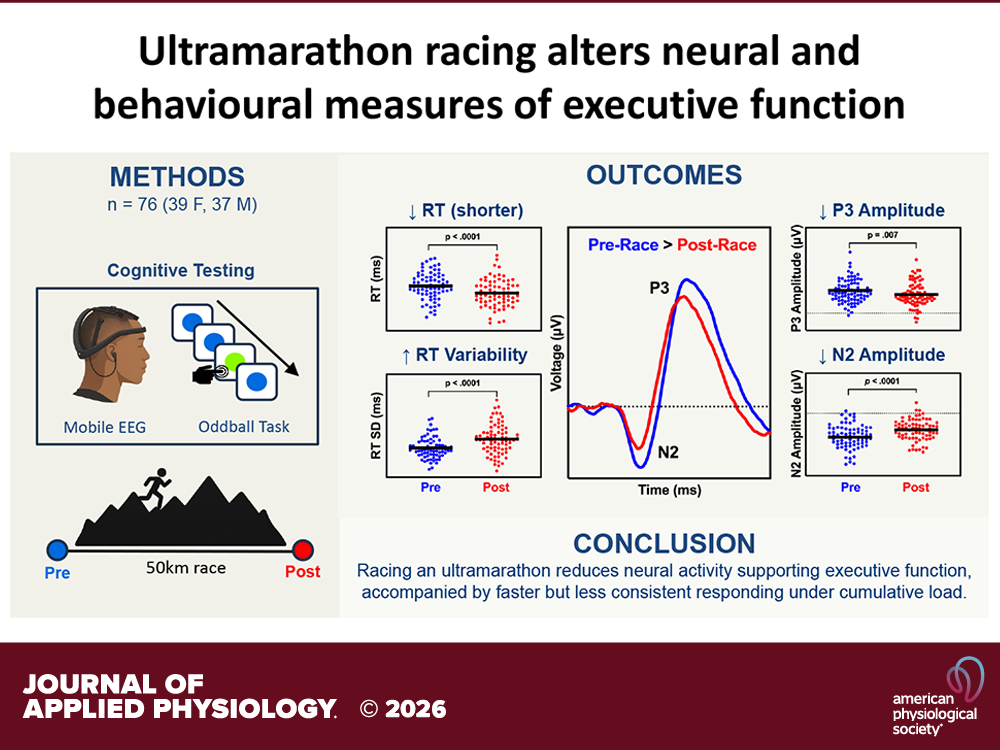
Graphical abstract showing study methods, EEG outcomes, and conclusion: ultramarathon racing reduces neural activity supporting executive function

Runners completed cognitive testing with mobile EEG before and immediately after racing a 50km ultramarathon. Brain signals related to inhibitory control and attention were significantly reduced post-race.

The brain is part of the performance equation.

We spend a lot of time measuring what happens to the body during extreme endurance — heart rate, oxygen, lactate, fuel. But what happens to the brain?

This study is the first large-sample electrophysiological evidence that ultramarathon racing reduces neural activity tied to executive function. That matters because executive function governs pacing decisions, fueling strategy, focus, and pain management — all things that separate finishing strong from falling apart.

And here's the kicker: your mental state before the race predicted how much your brain changed during it.

What the data showed

76

Runners studied across 6 ultramarathon races — the largest EEG sample in ultramarathon research to date.

28%

Drop in N2 amplitude post-race — the brain signal tied to inhibitory control. The ability to suppress impulses and regulate behavior was diminished.

18%

Drop in P3 amplitude — the signal tied to attentional allocation. The brain was paying less attention to what mattered.

14%

Increase in reaction time variability. Responses were faster on average but far less consistent — the brain shifted to a "fast but imprecise" mode.

What shaped the magnitude of change?

Pre-race psychological distress predicted larger brain changes

Runners with higher depression, anxiety, and stress scores (DASS-21) showed significantly larger reductions in P3 amplitude (r = 0.69). Mental health going into the race influenced cognitive resilience during it.

Motivation type mattered for inhibitory control

Runners driven by external motivation (guilt, self-worth, personal goals) showed greater N2 reductions — suggesting that sustained self-regulation during the race taxed the brain's inhibitory circuits more.

Fueling didn't explain the cognitive changes

Carbohydrate intake, hydration, and caffeine use weren't reliably associated with the brain signal changes. The cognitive effects appear driven by cumulative physiological strain, not nutrition alone.

Faster but less precise. That's what your brain becomes after 50km.

Ultramarathon racing pushes the brain into a state of heightened arousal alongside metabolic fatigue — producing quicker reactions but less stable, less controlled behavior. Diminished executive function under high physiological load could increase the likelihood of in-race decision errors: misjudging pace, neglecting fueling, or failing to adjust strategy under fatigue.

Training approaches that strengthen arousal regulation, cognitive flexibility, and stress resilience may help preserve executive function and reduce costly errors during ultramarathon performance.

Read the full paper ↗
Citation

Boere K, Young NP, Copithorne F, Dauphinee R, Heath M, Kirby BS, Krigolson OE. Ultramarathon racing elicits changes in behavioral and electroencephalographic indices of executive function. J Appl Physiol 140: 133–140, 2026. doi:10.1152/japplphysiol.00941.2025