The study at a glance
Graphical Abstract
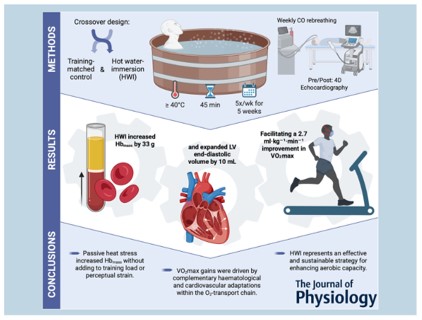
Crossover design: 5 weeks of hot water immersion after training increased Hb mass, expanded the heart's filling capacity, and improved VO₂max by 4.4% — without changing the training itself.
5 weeks of hot water immersion increased VO₂max by 4.4% in trained runners — without changing their training.
Passive heat acclimation produced hemoglobin mass gains comparable to altitude training, plus cardiac adaptations that altitude can't match.
Jenkins et al. (2025) — The Journal of Physiology
Crossover design: 5 weeks of hot water immersion after training increased Hb mass, expanded the heart's filling capacity, and improved VO₂max by 4.4% — without changing the training itself.
Athletes have long traveled to altitude camps to boost hemoglobin mass and oxygen-carrying capacity. It works — but it's expensive, logistically complex, and environmentally costly.
This study shows that sitting in hot water after training produces the same hemoglobin mass gains as altitude — plus something altitude doesn't give you: cardiac remodeling that increases how much blood your heart can pump per beat.
Heat expanded both the oxygen-carrying capacity of the blood and the heart's ability to deliver it. That dual mechanism is what makes this different.
Hemoglobin mass increase — a 3.9% gain, comparable to altitude training protocols of similar duration.
Blood volume expansion. More blood to carry more oxygen to working muscles.
Left ventricular end-diastolic volume increase — the heart physically expanded its filling capacity, pumping more blood per beat.
VO₂max improvement — a 4.4% gain in maximal oxygen consumption, with treadmill speed at VO₂max increasing by 0.8 km/h.
Hot water immersion expanded plasma volume in weeks 1-2, which lowered hematocrit and triggered the kidneys to produce more red blood cells. By weeks 4-5, hemoglobin mass had climbed 33g — the body's way of restoring the oxygen-carrying balance.
The expanded blood volume increased cardiac preload, stretching the left ventricle and increasing its filling capacity by 10 mL. Stroke volume rose by 7 mL — more oxygen delivered with every heartbeat.
Altitude training boosts hemoglobin mass but contracts plasma volume, limiting cardiac adaptation. Heat does the opposite — it expands plasma volume and drives both blood and heart adaptations simultaneously.
Same blood gains as altitude. Better heart gains. From a bathtub.
Passive heat acclimation produced VO₂max improvements comparable to live-high-train-low altitude camps — without travel, without cost, and without compromising training quality. Hemoglobin mass was the strongest predictor of gains, with cardiac remodeling providing additional benefit. The model explained 96% of the variance in VO₂max.
For athletes and teams looking to enhance oxygen transport without the logistics of altitude, hot water immersion offers a practical, sustainable, and physiologically effective alternative.
The Physiology of 4 Minutes identified oxygen delivery as the key limiter for the women's 4-minute mile — and listed "heat adaptation to unlock more oxygen" as a solution pathway. This paper provides the mechanistic evidence for exactly that.
See the Physiology of 4 Minutes →Jenkins EJ, Killick JA, Zerilli O, Douglas AJM, Corr L, Hughes MG, Tremblay JC, Stembridge M. Long-term passive heat acclimation enhances maximal oxygen consumption via haematological and cardiac adaptation in endurance runners. J Physiol. 2025. doi:10.1113/JP289874